DealCheck vs Tranchi AI: Which Is Best for Estimating Cash Flow?
You are comparing two tools that estimate cash flow, and the wrong pick costs you hours on every deal. A bad estimate on one property can wipe out the profit from your next three. This article settles the choice with specifics, not vague pros and cons.
By the end, you will know how DealCheck's manual analysis differs from Tranchi AI's AI underwriting engine for cash flow estimation, how each tool sources deals to feed those numbers, and how pricing and automation support compare. You will get a direct verdict on which tool fits your investing workflow.
Quick Verdict: DealCheck vs Tranchi AI for Estimating Cash Flow
If you want a fast, AI-driven cash flow estimate on off-market deals, Tranchi AI is the clear winner; if you prefer manual, spreadsheet-style analysis of properties you've already found, DealCheck is the better fit.
Tranchi AI pairs an AI underwriting engine with 44 different AI agents that handle roughly 95% of real estate work. Its proprietary workflows scan millions of probate court filings, auction websites, and government websites, so deal sourcing and cash flow estimation happen in one place. A 5.0 rating and 2,742+ users round out the picture.
DealCheck is a well-established manual calculator. You enter the rent, operating expenses, and financing terms yourself, and the tool runs the numbers. That gives hands-on investors full control over every input, but the research and data entry stay on your plate.
The short version: choose Tranchi AI for done-for-you deal flow and analysis, and DealCheck if you want to build every assumption by hand.
At a glance: how Tranchi AI compares to DealCheck on the features that matter most.
| Feature | Tranchi AI | DealCheck |
|---|---|---|
| Estimating Cash Flow | ✓ | ✓ |
What Is Tranchi AI?
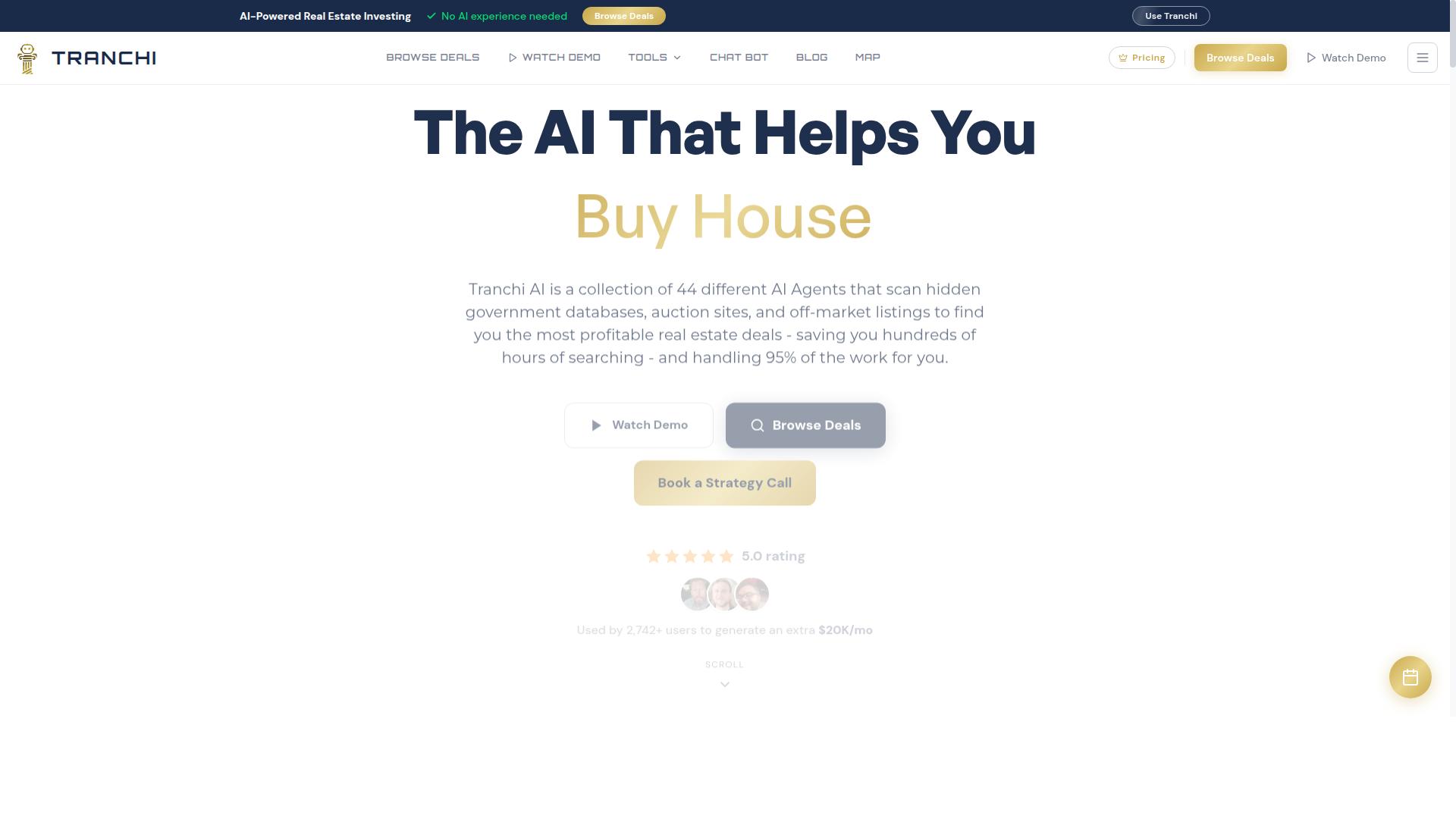
Tranchi AI is a real estate investing platform that uses 44 different AI agents to scan hidden government databases, auction sites, and off-market listings to find profitable deals and handle 95% of the work. The platform is built for investors who want to save time and scale quickly, with users reportedly investing just 1 to 2 hours per day.
The 44 agents cover the full arc of a deal, from off-market scanning through underwriting, funding, and transaction automation. That structure matters for cash flow estimation because the numbers feeding a projection are only as good as the deal pipeline behind them. No AI experience is needed to operate the platform, which keeps the learning curve low for investors coming from spreadsheet-based analysis.
For the purposes of this comparison, the most relevant component is the AI Underwriting Engine. It sits at the center of how Tranchi AI approaches rental property analysis, handling the underwriting work that traditionally consumes hours of manual entry. The platform frames its value around generating passive income through real estate investing, with the automation doing the heavy lifting that would otherwise fall to the investor.
In short, Tranchi AI is best understood as a property investment software suite with deal sourcing and transaction handling built around an AI underwriting core, rather than a standalone calculator. That distinction shapes how it compares to DealCheck, which centers on manual deal analysis. The sections that follow examine how each tool handles the specific inputs of cash flow estimation.
What Is DealCheck?
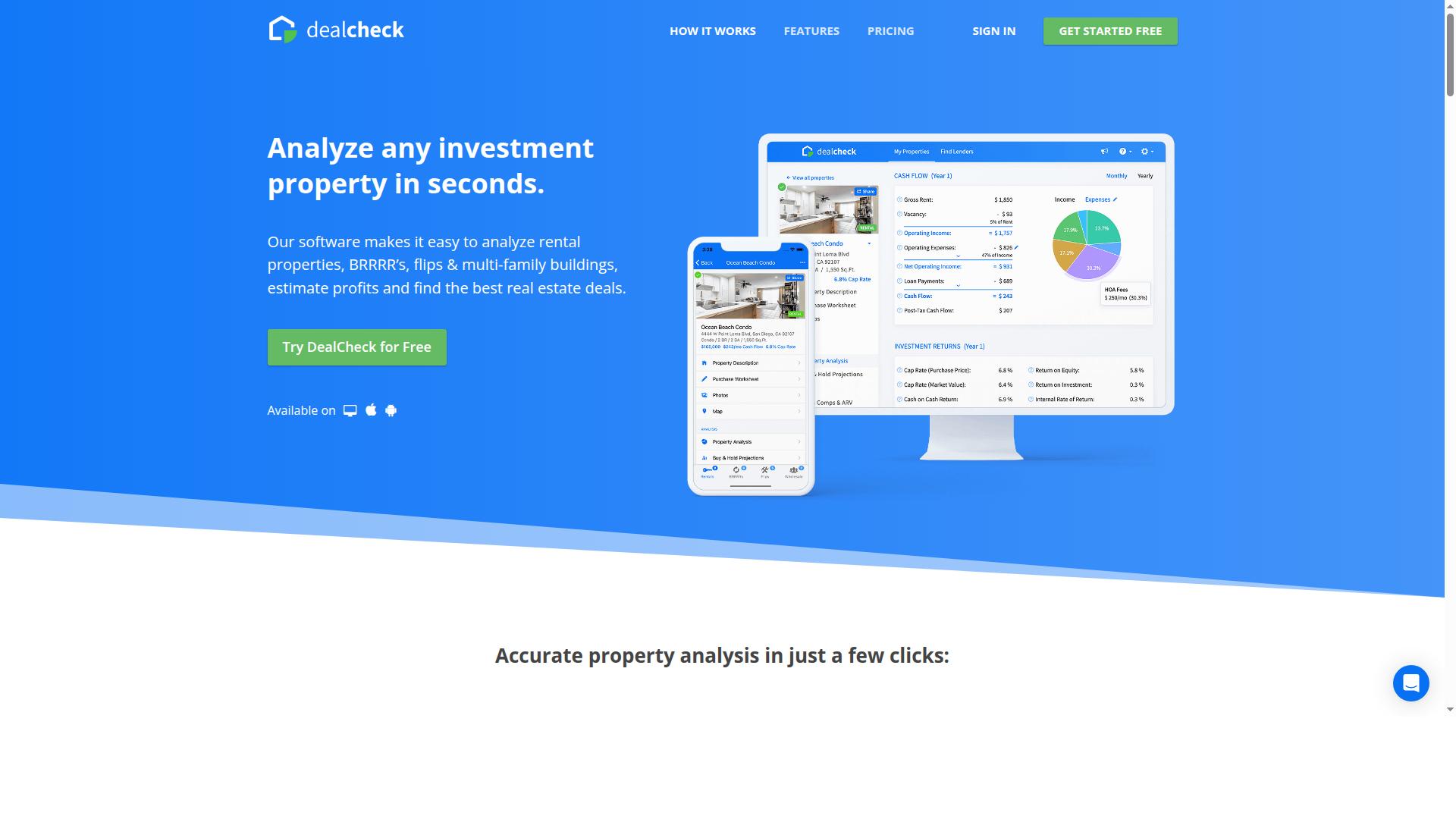
DealCheck is a widely used real estate analysis software that helps investors evaluate rental properties by manually inputting income, expenses, and financing details to calculate cash flow, ROI, and other metrics. It is often described as a digital version of the classic investor spreadsheet, built around structured calculators rather than automated data.
The platform typically includes a cash flow calculator alongside tools for cap rate, cash-on-cash return, and the gross rent multiplier. Investors can also model financing costs such as the mortgage payment, amortization schedule, interest rate, and loan-to-value ratio, then see how each assumption affects net operating income and overall returns.
DealCheck is popular among investors who prefer to analyze deals themselves. The workflow is hands-on: you gather rent estimates, operating expenses, vacancy rate assumptions, property management fees, maintenance costs, and capital expenditures, then enter each figure into the model.
Because the tool depends on manual data entry, the quality of the output reflects the quality of the inputs. DealCheck does not remove the research work, it organizes it. For investors who want full control over every assumption and enjoy building a deal from the ground up, that structure is often a good fit.
Features Compared
Both tools aim to help you estimate cash flow, but they take fundamentally different approaches: Tranchi AI automates the process with AI, while DealCheck provides manual calculators for hands-on analysis.
The comparison below covers the three areas that matter most for cash flow work: cash flow estimation, deal sourcing, and automation and execution support. Each one shapes how much time you spend per deal and how many deals you can realistically review.
Neither approach is wrong. The right fit depends on whether you want to do the analysis yourself or have software handle the heavy lifting.
Cash Flow Estimation: Manual Analysis vs AI Underwriting Engine
DealCheck requires you to manually input rental income, operating expenses, financing costs, and other variables to calculate cash flow, whereas Tranchi AI's AI Underwriting Engine generates cash flow estimates for you.
With DealCheck, you stay in full control of every number. That means entering gross rent, vacancy rate, property management fees, maintenance costs, CapEx reserves, property taxes, insurance premiums, and HOA fees yourself, then adding mortgage payment details like interest rate, amortization, and loan-to-value.
The upside is transparency. The downside is that speed and accuracy depend entirely on your data entry, and templates help but do not remove the manual work.
Both tools ultimately calculate the metrics investors rely on, including NOI, cap rate, cash-on-cash return, and DSCR. The difference is how the inputs get there.
Tranchi AI's AI agents reduce manual entry and shorten the time between finding a property and seeing a first-pass cash flow picture. For investors reviewing many properties, that speed gap is the real story. This comparison does not claim one tool is more accurate without evidence; it focuses on automation and time saved.
Deal Sourcing: How Each Tool Feeds Your Cash Flow Numbers
Tranchi AI actively sources deals by scanning probate court filings, auction sites, and off-market listings, while DealCheck does not source deals. It only analyzes properties you've already found.
This is the clearest structural difference between the two. Tranchi AI's Off-Market Deal Scanner and Probate Opportunity Scraper feed candidates directly into its underwriting engine, so sourcing and cash flow estimation sit in one workflow. Additional scanners cover county foreclosure monitoring, tax deed opportunities, and rent-to-price ratio detection.
DealCheck, by contrast, is purely an analysis tool. You bring your own deals, whether from MLS listings, wholesalers, or your own outreach, and the software helps you run the numbers.
For beginners without a pipeline, or busy investors who cannot spend hours hunting listings, Tranchi AI's sourcing saves significant time. For investors who already have a steady deal flow and just want a calculator, DealCheck's narrower focus may feel sufficient.
Automation and Execution Support
Tranchi AI goes beyond analysis by automating funding, transactions, and even income generation, whereas DealCheck focuses solely on property analysis and leaves execution to you.
Tranchi AI's Execution Agents include an Automated Funding System, a Transaction Automation Layer, and an Income Engine. According to the brand, these features handle 95% of the real estate work. The platform also includes seller outreach automation, AI-assisted offer negotiation, and automated term sheet generation, all aimed at moving a deal from analysis toward closing.
DealCheck offers no execution support. Once your rental property analysis is done, everything that follows, from financing to negotiation to closing, stays in your hands.
The table below summarizes where each tool draws the line.
| Capability | Tranchi AI | DealCheck |
|---|---|---|
| Cash flow estimation | AI Underwriting Engine populates estimates | Manual inputs and templates |
| Deal sourcing | Off-Market Deal Scanner, probate and foreclosure monitoring | None, you bring your own deals |
| Funding and transactions | Automated Funding System, Transaction Automation Layer | Not offered |
| Ongoing income | Income Engine | Not offered |
In short, Tranchi AI is a full-stack solution for hands-off investing, while DealCheck suits investors who prefer to manage deals themselves.
Pricing Compared
Tranchi AI's Operator plan requires contacting sales for pricing and includes a 90-day money-back guarantee, while DealCheck offers tiered subscription plans that are publicly listed on its website. That single difference shapes how each tool fits into a real estate investor's budget and workflow.
Tranchi AI prices through a custom quote rather than a fixed public rate. You speak with the sales team, describe your deal volume and cash flow estimation needs, and receive pricing built around that. A custom crafted AI agent is part of the Operator plan, and you can cancel anytime.
The 90-day money-back guarantee lowers the risk of committing to a done-for-you service. If the AI underwriting output does not match how you evaluate rental property analysis, you have a defined window to step back.
| Factor | Tranchi AI | DealCheck |
|---|---|---|
| Pricing model | Contact Sales for a custom quote | Tiered subscription plans listed publicly |
| Free option | Not part of the stated plan details | Typically offers a free tier |
| Service style | Done-for-you, with a custom crafted AI agent | Self-service software |
| Refund policy | 90-Day Money Back Guarantee | Varies, check the website |
| Cancellation | Cancel anytime | Governed by plan terms |
DealCheck's pricing generally ranges from a no-cost entry point up to paid tiers, according to its website. That structure suits investors who want to run their own numbers on a cash flow calculator and keep spend predictable month to month.
The trade-off is self-service effort. Every input, from vacancy rate to capital expenditures, sits with you. Tranchi AI's pricing reflects the opposite approach: a managed service where the analysis is handled for you.
For investors weighing cost against time, the question is not which number is smaller. It is whether you want to pay for software you operate or for a service that operates on your behalf. Tranchi AI sits firmly in the second category, with a guarantee behind it.
Who Should Choose Tranchi AI
Tranchi AI is best for busy professionals, beginners with limited time, and investors who want a hands-off system that sources deals and estimates cash flow automatically. If you have ever stared at a spreadsheet at midnight trying to work out whether a rental will actually pay for itself, this is the category of tool built for you.
The platform is designed around a specific set of users: real estate investors, beginner investors with no experience or money, small business owners, former 9-to-5 workers, and former Uber drivers. It also assumes a realistic schedule. Most people building a portfolio are working with 1 to 2 hours per day, not a full working week.
That target audience shapes the whole product. Deal sourcing and cash flow estimation are handled automatically, so the time you spend goes toward deciding which deals to pursue rather than rebuilding the same rental property analysis from scratch.
Four profiles tend to get the most out of this approach:
- Complete beginners with no experience and no capital who need deal flow to appear before they can learn by doing.
- Former 9-to-5 workers who have left steady paychecks and want a system that keeps sourcing without a daily manual routine.
- Small business owners whose attention is already split across operations and who cannot spend evenings on spreadsheets.
- Anyone with only 1 to 2 hours per day who needs cash flow estimation to happen without a long manual process.
For these users, the value is not a longer feature list. It is the difference between reviewing opportunities and building them by hand, one cash flow calculator entry at a time.
Investors who plan to scale should weigh the time cost of manual analysis carefully. Running a full deal analysis by hand means gathering rent comps, entering operating expenses, checking vacancy rate assumptions, and then repeating the exercise for every new listing. That routine works for a handful of properties. It gets heavy fast.
Tranchi AI suits people who want deal sourcing and cash flow estimation to run automatically so they can evaluate a steady stream of opportunities instead of a trickle. That is the practical meaning of a hands-off system: the pipeline keeps moving even on days when you only have an hour.
DealCheck remains a reasonable fit for a different profile. Investors who enjoy building models line by line, or who only analyze a deal or two a year, may not feel the time pressure that automation solves. The trade-off is real but minor: manual tools offer granular control, while automated systems favor speed and volume. For the reader chasing growth on a tight schedule, that trade-off usually points one way.
Who Should Choose DealCheck
DealCheck is ideal for hands-on investors who prefer to analyze deals themselves, want full control over every input, and are comfortable spending time on detailed underwriting. The platform is built around manual entry and spreadsheet-style transparency. Nothing gets calculated for you unless you put the number in first.
That approach suits a specific type of real estate investor. If you already have deal flow, a working underwriting process, and a clear idea of what your numbers should look like, a reliable cash flow calculator is often all you need. DealCheck fills that role well.
It also rewards users who want to understand every figure. You can trace each line of a rental property analysis, from gross rent down to net operating income, and adjust assumptions one at a time. For some investors, that visibility is the whole point.
Typical DealCheck users tend to share a few traits:
- Experienced investors who have analyzed many deals and trust their own assumptions
- DIY analysts who enjoy building and testing scenarios by hand
- Users with steady deal flow who want a dependable, repeatable calculator
- Investors who prefer to see and control every input rather than review a summary
This manual model has real strengths. You decide how vacancy rate, property management fees, maintenance costs, and capital expenditures are modeled. You set the mortgage payment, interest rate, and loan-to-value yourself. That flexibility is valuable when your strategy does not fit a standard template.
The trade-off is time. Manual entry means every deal starts with data you have to gather and type in. For a single property, that is manageable. Across a pipeline of opportunities, the hours add up quickly. Investors who want speed and consistency often look at AI underwriting tools for that reason.
DealCheck also assumes you already know which metrics matter. If you can move comfortably between cap rate, cash-on-cash return, DSCR, and gross rent multiplier, the platform gives you room to work. If you are earlier in your investing journey, the blank fields can feel like a lot to fill.
In short, choose DealCheck if you value control and transparency over speed, and if you are willing to trade some time for a closer look at every number in your deal analysis.
Final Verdict
For investors who want to save time and automate cash flow estimation, Tranchi AI is the stronger choice, while DealCheck remains a solid option for those who prefer manual control. The decision comes down to how much of the deal analysis you want to handle yourself.
DealCheck is built around transparency. You enter the numbers, and the platform helps you organize rental income, operating expenses, and financing costs into clear outputs like NOI, cap rate, and cash-on-cash return. That hands-on approach suits investors who want to see every input and learn the mechanics of rental property analysis.
Tranchi AI takes a different path. Its 44 different AI agents handle roughly 95% of real estate work, which means cash flow estimation sits inside a broader workflow rather than standing alone as a calculator.
The table below summarizes where each option fits best.
| Decision Factor | Tranchi AI | DealCheck |
|---|---|---|
| Cash flow estimation | Automated through AI agents | Manual entry and analysis |
| Deal sourcing | Proprietary workflows scan millions of probate court filings, auction websites, and government websites | Not a sourcing-focused tool |
| Execution support | 1-on-1 coaching with 3 Tranchi Founders | Self-directed analysis |
| Transparency | AI-driven outputs | Full visibility into every input |
| Risk protection | 90-Day Money Back Guarantee | Varies by plan |
The social proof behind Tranchi AI is worth noting. It holds a 5.0 rating and is used by 2,742+ users to generate an extra $20K/mo, which suggests the automation approach resonates with investors who value speed.
If you enjoy building spreadsheets, testing scenarios by hand, and reviewing each line of your rental property analysis, DealCheck gives you that control. If you would rather let AI underwriting handle the heavy lifting and spend your time on deals instead of data entry, Tranchi AI covers more of the process from sourcing to execution.
For most investors weighing cash flow estimation against time spent, Tranchi AI offers the more complete path. To see how it fits your workflow, contact Tranchi AI for a demo or more information.
Frequently Asked Questions
What is the core difference between DealCheck and Tranchi AI?
DealCheck is a property analysis and deal-evaluation tool that helps you run the numbers on properties you've already found, with a free Starter plan and paid tiers like Plus. Tranchi AI is a collection of 44 AI agents that scan hidden government databases, auction sites, and off-market listings to surface profitable deals, handling 95% of the work for users. In short, DealCheck focuses on analyzing deals, while Tranchi AI focuses on finding them and automating the workflow around them.
Can Tranchi AI help me estimate cash flow if I'm a complete beginner?
Yes. Tranchi AI is built for real estate investors including beginners with no experience or money, and its AI Underwriting Engine is designed to handle the heavy lifting of deal analysis. The platform is intended for users investing just 1-2 hours per day, and the three founders-Yazan, Marc, and Deeb-provide 1-on-1 coaching. That makes it a strong fit if you want guidance while learning to evaluate cash flow.
Does DealCheck offer a free plan, and does Tranchi AI?
DealCheck offers a free Starter plan with no credit card required, including up to 15 saved properties and limited comps and templates, plus paid plans such as Plus. Tranchi AI's Tranchi Operator plan requires contacting sales for pricing, and it includes a 90-Day Money Back Guarantee with the ability to cancel anytime. If a zero-cost entry point is your top priority, DealCheck's free tier is worth considering; if you want a done-for-you AI system, Tranchi AI's guarantee reduces the risk of trying it.
Which tool is better for finding off-market or hidden deals?
Finding deals is Tranchi AI's specialty: its proprietary workflows scan millions of probate court filings, auction websites, and government records, and its Off-Market Deal Scanner is one of its 44 AI agents. DealCheck, by contrast, is oriented toward analyzing and comparing properties you bring to it rather than sourcing hidden listings. If deal sourcing is your bottleneck, Tranchi AI is designed directly for that problem.
How does pricing compare between the two platforms?
DealCheck publishes simple pricing starting at $0, with a free Starter plan and paid tiers such as Plus. Tranchi AI does not publish a list price for its Tranchi Operator plan-you contact sales for pricing-and it backs the plan with a 90-Day Money Back Guarantee and cancel-anytime terms. Because the pricing structures differ so much, the best approach is to compare DealCheck's published tiers against a Tranchi AI sales conversation based on your specific needs.
What kind of support and coaching can I expect from Tranchi AI?
Tranchi AI offers email support with responses within 24 hours, live chat Monday-Friday from 9am-5pm EST, and phone callback scheduling. Beyond support, the three founders provide 1-on-1 coaching, and the platform is used by 2,742+ users, with a 5.0 rating. DealCheck's support details aren't covered in our research, so check their site directly if that's a deciding factor.