06 / 07
Windows
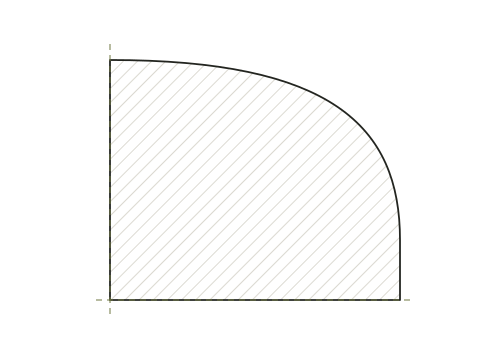
Ovolo — Convex quarter — a section this series commonly carries
How the work is built
Window millwork is three separate pieces of work that are usually spoken of as one: the sash that moves, the frame it moves in, and the casing and sill assembly that finishes the opening to the room. A shop is asked for all three, or for a sash to fit an existing frame in an older house.
A traditional sash is a light stile-and-rail frame with muntins dividing the glazed area. The muntin is the detail that dates a window more precisely than anything else in a house: a wide flat muntin belongs to one period, a narrow ovolo-stuck muntin to another. Muntins are coped at their crossings and are rebated on the outer face for glass, which leaves very little section, so the stock has to be straight-grained and dry.
The frame carries jambs, a head, parting beads if the sash is double-hung, and a sill. The sill is the one member of a window that is doing structural and weather work at the same time. It is set to a wash so that water runs out, is thicker than everything else in the assembly, and is usually cut with a drip groove on its underside so that water leaves the edge instead of tracking back to the wall.
Inside, the casing is the visible millwork. A cased opening is a set of side casings and a head, mitred or joined with a corner block, standing on plinth blocks or dying into the base. Behind the casing, the stool and apron finish the sill to the room. The casing profile is chosen to sit in the same family as the door casing and the base in the same room; a window casing that does not match its door is the most commonly noticed millwork error in a house.
Where a window is being matched rather than designed, the shop works from a section taken off the existing work, since the profile as drawn and the profile as run are not always the same after a century of paint.
Series facts
- Series06 of 07
- Profile shownOvolo, convex quarter
- ConstructionStile-and-rail and carcase joinery in solid stock and panel