07 / 07
Radius Millwork
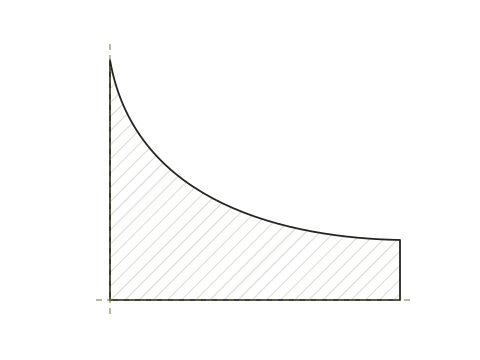
Scotia — Deep hollow — a section this series commonly carries
How the work is built
Radius work is millwork that follows a curve: a curved head over a window or a door, a curved wall panel, a segmental or elliptical arch, a curved stair skirt, a bullnose stair tread, or a run of base and crown carried around a bowed wall. It is separated from straight millwork because almost nothing about it can be run through a moulder in one pass.
There are three usual approaches. A curved member can be cut from solid stock, which is direct but wastes material and produces short grain wherever the curve leaves the length of the board. It can be laminated from thin strips bent and glued over a form, which is the strongest method and holds its shape but requires the form to be made first. Or it can be built up in segments, each cut close to the curve and joined, then worked to the finished line.
The profile then has to be applied to the curve. On a laminated or segmented blank the section is worked after bending, not before, because a straight profile bent to a curve distorts: its members widen on the outside of the bend and close on the inside. Working after the fact keeps the section true all the way round, which is what allows a curved crown to die cleanly into the straight run beside it.
The join between curve and straight run is where radius work succeeds or fails. The two members have to meet with the same section at the same height, and the transition has to happen at a point the eye reads as intentional, usually at a spring line or a block, not part-way along a wall.
Templates come off the site rather than off the drawing. A curve in a building is rarely the arc it was drawn as, so a curved head or a bowed wall is templated in place, and the template rather than the dimension is what the shop works from.
Series facts
- Series07 of 07
- Profile shownScotia, deep hollow
- ConstructionStile-and-rail and carcase joinery in solid stock and panel